
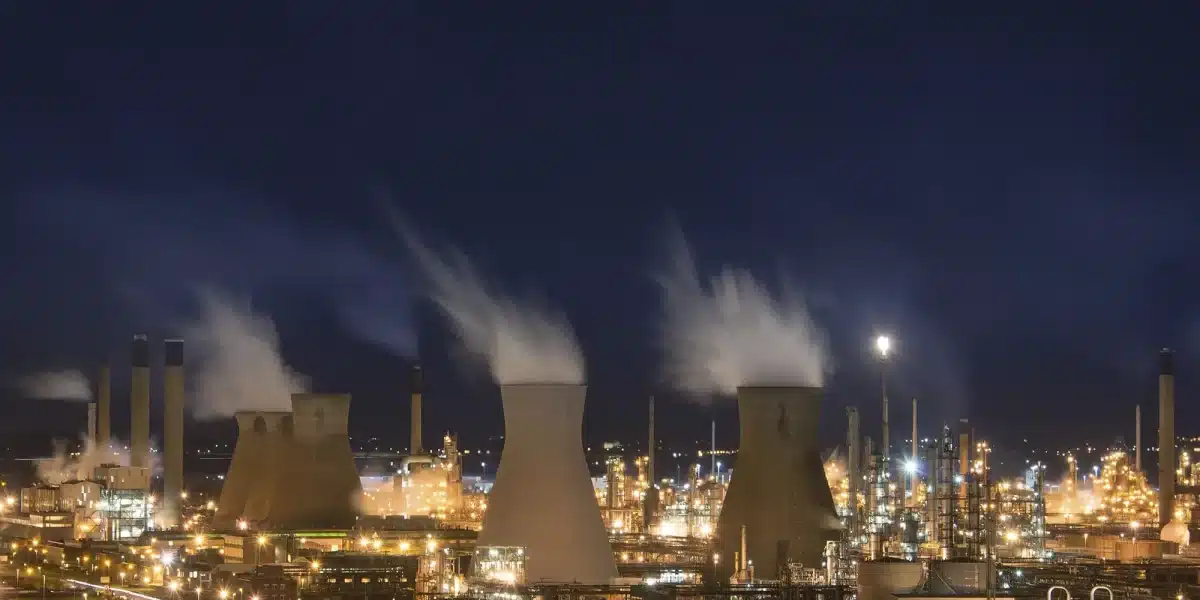
- Project Name: Cooling Towers in Petrochemical Industry
Role, Function, and Importance
Petrochemicals is one of the world’s vital and complex industries, whose processes require precise and controlled temperatures. The cooling tower is a key piece of equipment in this industry, playing a critical role in managing heat and maintaining the efficiency of chemical processes. This article examines the function, applications, and importance of cooling towers in the petrochemical industry.
Why is the Cooling Tower Important in the Petrochemical Industry?
In petrochemical processes, the production of various products involves generating significant heat which, if not properly managed, can lead to a decline in product quality, reduced equipment efficiency, and increased operational costs. The cooling tower, as a heat exchange system, helps optimize these processes by dissipating excess heat and cooling the circulating water.
How the Cooling Tower Functions in Petrochemical Industry
Cooling towers in the petrochemical industry operate in two ways: direct and indirect:
1. Direct Cooling (Open Circuit):
In this method, hot water from chemical processes enters the tower and comes into direct contact with air. As a result, a portion of the water evaporates, and the heat is transferred to the air.
2. Indirect Cooling (Closed Circuit):
In this method, hot water passes through closed pipes, and the heat is transferred to the air through the pipe walls, without the water coming into direct contact with the air. This method is more suitable for processes that require water purity.
Applications of Cooling Towers in the Petrochemical Industry
1. Equipment Temperature Control: The cooling tower maintains the temperature of sensitive equipment such as heat exchangers, reactors, and condensers within an optimal range. This prevents damage to the equipment and extends their service life.
2. Improving the Efficiency of Chemical Processes: Many chemical reactions occur at specific temperatures. By managing the temperature, the cooling tower helps increase the efficiency of these reactions.
3. Reduced Energy Consumption: Cooling towers reduce energy consumption by utilizing water evaporation instead of high-consumption cooling equipment.
4. Environmental Sustainability: By using advanced cooling towers, water evaporation can be controlled, and water consumption can be optimized, which helps reduce environmental impacts.
Advantages of Using Cooling Towers in the Petrochemical Industry
Reduced Operational Costs: By optimizing energy and water consumption.
Increased Equipment Efficiency (or Productivity): Suitable process temperatures lead to extended equipment lifespan and reduced breakdowns.
Sustainability and Compliance with Environmental Regulations: Up-to-date cooling towers reduce water and energy consumption and are compliant with environmental standards.
Challenges and Solutions for Cooling Towers in the Petrochemical Industry
Challenges:
1. Deposition:
Minerals present in the water can deposit on the packings and reduce the cooling efficiency.
2. Corrosion: Tower equipment may suffer from corrosion due to continuous contact with water and air.
3. High Water Consumption: The evaporation process in open-circuit towers leads to water loss.
Solutions:
Use of anti-corrosion and anti-fouling packings to increase the durability of the equipment.
Using anti-corrosion chemicals and water treatment to improve water quality.
Implementing hybrid cooling towers that have lower water consumption.
Impact of Forced Draft Cooling Towers in the Petrochemical Industry
Sardab Sazan Gostar Shargh Company has specifically addressed the needs of the petrochemical industry by designing and manufacturing forced draft cooling towers. These towers offer the following advantages:
Up to 40% Reduction in Water Consumption: The use of forced draft technology has optimized water consumption.
Long-life packings:
Polypropylene and polyethylene packings, resistant to fouling and corrosion.
Foundation-Free Design: Easy installation and reduced ancillary costs.
Summary
Cooling towers in the petrochemical industry are one of the key components for maintaining the efficiency and productivity of industrial processes. By managing temperature and dissipating excess heat, these towers help improve product quality, reduce operational costs, and preserve the environment. Selecting the appropriate cooling tower, considering the specific needs of each industrial unit and environmental conditions, is of high importance.
“Sardab Sazan Gostar Shargh Company, by offering the new generation of forced draft cooling towers, is a reliable partner for the petrochemical industry.”