
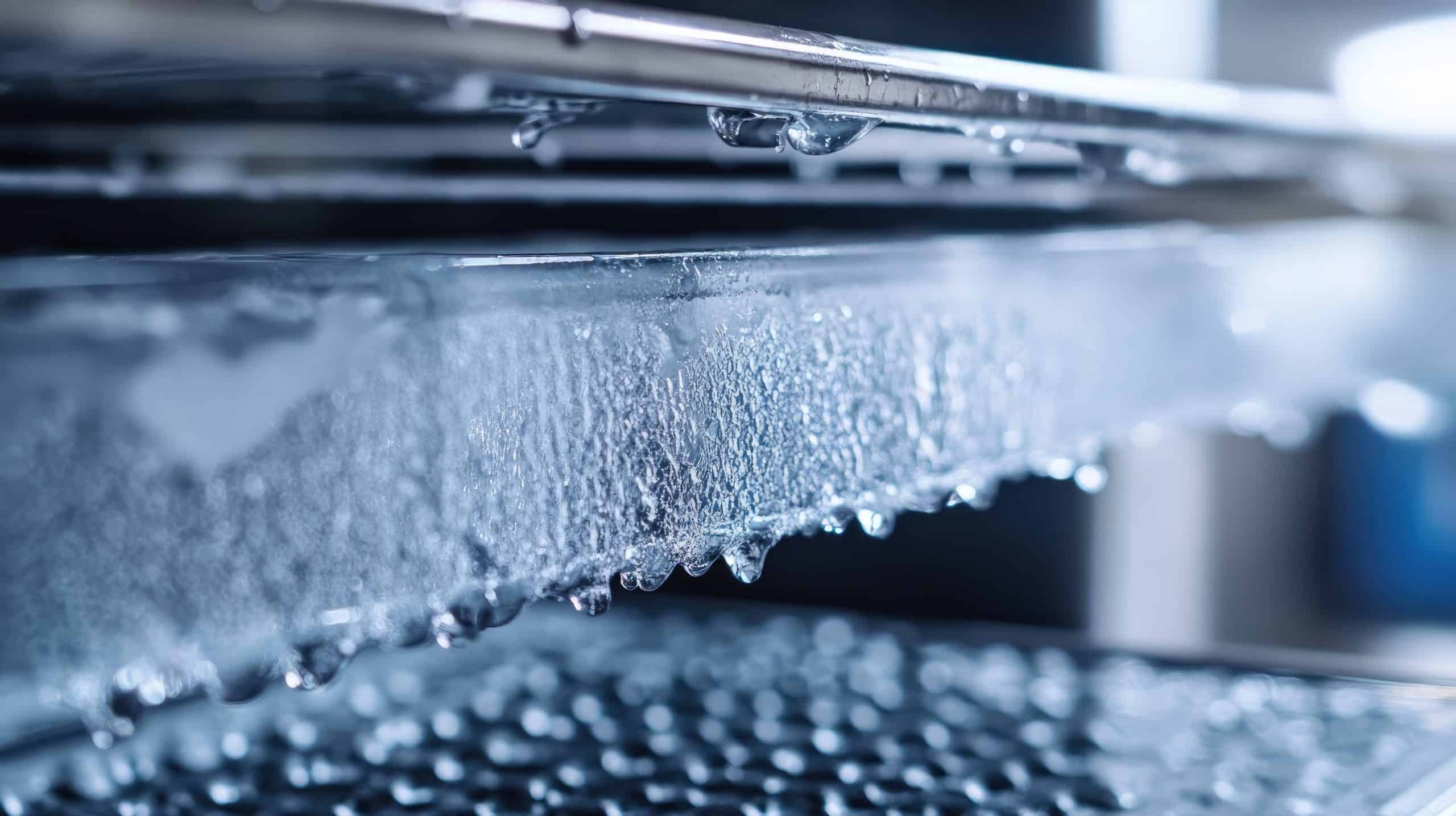
The refrigeration cycle is the backbone of all cooling technologies that make our lives more comfortable. From small household refrigerators to massive industrial cold storage facilities and advanced HVAC systems in skyscrapers, they all operate based on a simple yet powerful scientific principle: the phase change of a fluid to absorb and release heat. In the following, we will provide a complete introduction to this process, its components, and its vital role in today’s world.
What is the Refrigeration Cycle and How Does It Work?
Simply put, the refrigeration cycle is a thermodynamic process that uses a chemical substance called a refrigerant to extract heat from one environment and transfer it to another. This cycle is based on the physical fact that any substance absorbs heat from its surroundings when it changes phase from liquid to gas (evaporation). This process consists of four key stages, which are repeated continuously in a closed loop.

The Four Main Components of the Refrigeration Cycle and Their Roles
Every refrigeration system consists of four main components that work together precisely to enable the cooling process:
- Compressor: The Heart of the System
The compressor is the main engine of the cycle. Its role is to compress the low-pressure gaseous refrigerant coming from the evaporator. Through compression, the refrigerant’s temperature rises significantly, transforming it into a high-pressure, hot gas. This crucial stage provides the energy needed to drive the entire cycle. - Condenser: The Heat Releaser
The high-pressure, hot refrigerant from the compressor enters the condenser. The condenser consists of a series of metal tubes and fins (similar to a radiator). Here, heat is transferred from the refrigerant through the tubes to the surrounding environment, usually air or water. As the refrigerant loses heat, it condenses into a high-pressure liquid, ready for the next stage. - Expansion Valve: The Flow Regulator
This valve has a very important role. The high-pressure liquid refrigerant from the condenser enters the expansion valve. Through a very small orifice, the valve sharply reduces the refrigerant’s pressure. This sudden drop in pressure causes the refrigerant’s temperature to fall significantly (often below ambient temperature) and allows it to enter the evaporator as a mixture of liquid and gas. - Evaporator: The Heat Absorber
The low-pressure, cold refrigerant from the expansion valve enters the evaporator. The evaporator is located in the environment that needs to be cooled (e.g., inside a refrigerator or a room). As the refrigerant absorbs heat from the surroundings, it begins to evaporate. This evaporation process extracts thermal energy from the environment, cooling it down. After absorbing heat, the refrigerant fully transforms into a gas and returns to the compressor, restarting the cycle.

Diverse Applications of the Refrigeration Cycle
Refrigeration technology goes beyond everyday uses and plays vital roles in various industries:
- Food Industry:
Preserving food in cold storage and warehouses, transporting meat and dairy products with refrigerated trucks, and beverage production. - Medical and Pharmaceutical Industry:
Storing vaccines, laboratory samples, and medications at very low temperatures. - Industrial Production:
Cooling industrial machinery, plastic injection molds, and chemical processes to enhance efficiency and product quality. - Information Technology:
Cooling data centers and large computer servers, which require advanced cooling systems to prevent damage.
Given these wide-ranging applications, choosing high-quality and optimized refrigeration systems is a smart investment to reduce energy costs and ensure process sustainability. Leading companies in this field provide modern and intelligent refrigeration solutions, helping industries achieve the highest levels of efficiency.